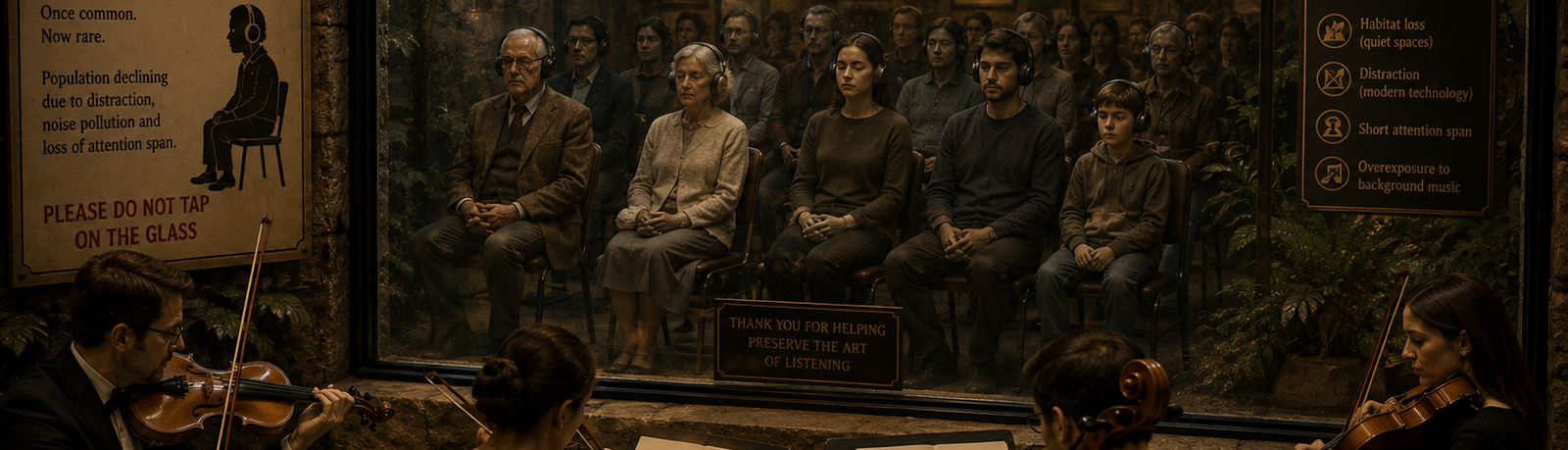
What the Benvenuti Collection taught me about “light music”, live performance, and the lost art of listening
Working with the Benvenuti Collection has forced me to think about a category of music I had previously accepted without much question: “light music”.
The collection contains thousands of pieces used by musicians from the late nineteenth century well into the twentieth — many such collections would exist around the world. There are marches, waltzes, quadrilles, lancers, overtures, descriptive pieces, salon works, arrangements, ragtime, music for dancing, music for silent films, music evoking distant countries and cultures, and works intended simply to be heard in concert.
Much of it falls under that wonderfully convenient historical label: light music.
The more of it I see, the less satisfactory the term becomes.
It seems extraordinary that perhaps fifty years of enormously varied musical activity can be bundled into a single category whose very name quietly implies that the music is somehow less substantial than the “serious” repertoire surrounding it. Beethoven is serious. Mahler is serious. Wagner is serious. But a waltz, march, descriptive fantasia or theatre piece is “light”.
Even people sympathetic to the Benvenuti Collection often try to rescue the repertoire by saying something like, “Well, it was the pop music of its day.”
I understand what they mean. They are trying to say that this was the music ordinary people knew and enjoyed; that it had a large audience; that it was part of everyday cultural life.
But the comparison still makes me uncomfortable.
It feels as though we are saying: this music was not Beethoven or Mahler, but that is all right, because neither is Taylor Swift.
Why should either comparison be necessary?
A march is not a failed symphony. A waltz does not need to apologise for not being Mahler. A piece written to accompany a silent film does not need the harmonic complexity of Wagner before we allow it to have artistic value.
Perhaps the problem is not the music at all.
Perhaps the problem is us.
Music before recording
The oldest surviving musical instruments are more than 40,000 years old.
Allow for all the uncertainties inherent in archaeology, and the broad point remains remarkable: human beings have been deliberately making music for tens of thousands of years.
Recorded sound, radio broadcasting and the widespread domestic consumption of reproduced music belong only to the most recent century or so.
In other words, for something like 99.75 per cent of the known history of human music-making, there was only one way to hear music: someone had to make it.
If you wanted to hear a song, someone sang. If you wanted to dance, musicians played. If you wanted an orchestra, the orchestra had to be physically assembled.
Music happened in a particular place, at a particular time, and was made by particular people.
Then it disappeared.
There was silence before it began and silence after it ended.
That fact seems so obvious that it is easy to miss how radically different it is from our own experience.
For most of human history, music was not an object that could be summoned.
It was an event.
The invention of background music
The arrival of recorded and broadcast music changed something fundamental.
I can imagine an early family gathered around a radio, listening with intense concentration to a concert or broadcast. The radio itself was extraordinary. Music had entered the home without musicians.
But gradually the novelty must have faded. Someone continued listening while preparing dinner. Someone else picked up the evening newspaper. The radio stayed on. Music continued while other things happened.
Later came records, portable radios, cassette players, the Walkman, compact discs, MP3 players, streaming services and wireless headphones.
Each development made music easier to access. Each development also made it easier not to listen.
Today, many of us are surrounded by more music than any humans in history and may spend remarkably little time actually listening to it. We hear music while driving. We hear it while exercising. We hear it while cooking, shopping, studying and working. We put on headphones while walking. We fill silence almost automatically.
There is nothing inherently wrong with any of this. I do it too.
But there is a difference between hearing music and listening to it. And perhaps, over the past hundred years, that difference has become increasingly important. Music has gradually moved from being an event to being an environment.
But were people ever really listening?
There is an obvious objection. People in earlier centuries did not always sit silently and reverently before music. Opera audiences talked, ate, drank and socialised. Music accompanied dancing, military movement, religious ritual, public celebration and private entertainment. In many contexts, music was never intended to command undivided attention.
That is true.
But I think there is still an important difference.
When people danced to a quadrille in 1880, the music was being made in the room. The musicians and dancers occupied the same space. The dancers responded physically to the musicians. The musicians responded to the dancers. Tempo, energy, repetition and atmosphere existed within a shared event. Dancing, in that sense, is not necessarily evidence that people were failing to listen. Perhaps the body was listening too.
Indeed, dance may be one of the oldest demonstrations of music’s emotional power. Music is heard, the body responds, and movement follows.
Silent film presents a different case again. There, the listener’s attention was certainly divided between sound and image, but the division was intentional. The music and the film together created the aesthetic experience. The music was not merely wallpaper beneath another activity. It was part of the work.
What seems different about the modern world is not that music accompanies other things. It always has. What is different is the sheer ease with which music can now become incidental.
It can be everywhere and nowhere.
The problem with “light music”
This returns me to the Benvenuti Collection.
Perhaps one reason this repertoire is so easily dismissed today is that we encounter it under entirely different listening conditions from those for which it was created.
A piece of music written for a theatre orchestra in 1910 may sound trivial when heard through laptop speakers while answering emails.
A waltz may seem repetitive when detached from the physical experience of dancing.
A march may appear simplistic when divorced from the procession, ceremony or public space for which it was intended.
A piece of silent-film music may seem hopelessly episodic when there is no film.
And a short descriptive work designed to charm, surprise or move an audience over the course of five minutes may have little chance of revealing itself when sampled for thirty seconds on a streaming service.
Perhaps we have been asking the wrong question.
When we open a forgotten score from 1905, we tend to ask: Is this music good enough to deserve being played today?
But perhaps another question should come first: Are we still capable of listening to it in the way that allows it to do what it was designed to do?
That question interests me far more.
Nothing is better than anything
The history of music is often taught as though it were a progression.
Renaissance leads to Baroque. Baroque leads to Classical. Classical leads to Romantic. Romantic leads to Modern.
The implication is easy to absorb: music became more sophisticated as it progressed.
But was Baroque music “better” than Renaissance music? Was Romantic music better than Classical music? Is Mahler better than Mozart because the orchestra is larger? Are complex harmonies inherently superior to simple ones?
Of course not.
Music changes.
Its materials change. Its social function changes. Its instruments change. Its audiences change. Its fashions change.
But change is not the same thing as improvement.
The same applies to so-called “light music”. It should not need to compete with Beethoven in order to justify its existence.
Its value may lie somewhere entirely different: in movement, immediacy, atmosphere, melody, memory, social function, humour, sentiment, theatricality or emotional directness.
A Toulouse-Lautrec poster does not need to prove itself against the ceiling of the Sistine Chapel.
They are different things.
Why should music be treated differently?
Put the musicians back in the room
There is a simple experiment I would like to conduct with the Benvenuti Collection.
Take one of these forgotten pieces out of its box. Put the parts on music stands. Assemble the musicians. Put an audience in front of them. Turn off the phones. Let the room become quiet. Then play the piece.
Do not explain apologetically that it is “light music”. Do not say that it was “the pop music of its day”. Do not warn the audience that it is not Beethoven.
Just play it.
And listen.
Then decide what it is worth.
Because something happens in a room containing live musicians that cannot be fully reproduced by a recording.
A note is produced by a human breath. A bow touches a string. A drum is struck. A phrase is shaped and released into the room. The audience experiences the same sound at the same moment. No one can pause it. No one can skip ahead. No algorithm chooses the next movement. The music exists only for the time in which it is being made.
Then it is gone.
For more than 40,000 years, this was not a special category called “live music”.
It was simply music.
The endangered listener
The more I work with endangered music, the more I wonder whether the music is only half the problem.
We worry about lost scores. We preserve manuscripts. We catalogue libraries. We digitise fragile parts. We restore forgotten works.
All of that matters.
But perhaps another thing is disappearing alongside them.
The listener.
Not the biological capacity to hear music. Human beings are not suddenly going to lose their ears. The danger is more subtle than that.
We may lose the habit of giving music our full attention.
Listening requires practice. Concentration requires practice. Stillness requires practice. Allowing a piece of music ten minutes in which it is the only thing asking for our attention now feels almost extravagant.
Perhaps this is why live performance matters more than ever. Not because recordings are bad. Not because technology has ruined music. Not because people in the nineteenth century were somehow better listeners than we are.
But because live performance creates conditions in which listening becomes difficult to avoid.
Musicians gather. An audience gathers. The doors close. The room becomes quiet. The first note is played.
For a little while, nothing else needs to happen.
That basic human transaction is astonishingly ancient.
Forty thousand years of cultural and technological change separate us from the people who made the earliest surviving musical instruments. And yet put musicians in front of listeners today and something recognisable remains.
One human being makes a sound. Another human being attends to it.
Perhaps the future of endangered music depends not only upon preserving what people once played. Perhaps it also depends upon preserving what people once did when the music began.
They listened.