Architects of Catharsis
In discussions of music and emotion, the listener usually occupies centre stage. Music moves us, comforts us, exhilarates us, sometimes even transforms us. Entire philosophies of music have been built around this idea: that sound possesses the mysterious ability to shape our inner lives.
But this raises an intriguing question. If music can produce such powerful emotional experiences, what happens to the people performing it?
The situation of the musician is unusual. The listener is free to surrender to the experience; the composer may experience catharsis in the act of creation. The performer, however, occupies a position somewhere between technician and artist. Their task is not primarily to experience the music but to construct the conditions in which others may experience it.
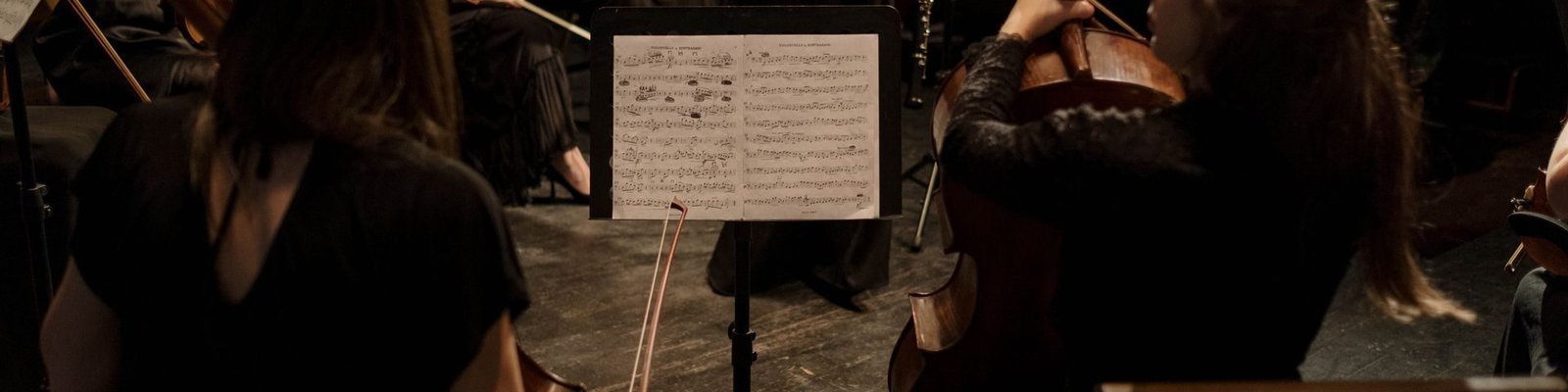
This requires a level of concentration that listeners rarely appreciate. A violinist in the middle of a symphonic climax may appear emotionally transported, yet their mind is simultaneously occupied with a dozen practical concerns: intonation, bow distribution, ensemble balance, the conductor’s beat, the upcoming page turn, the difficult shift in the next phrase. A brass player delivering a heroic passage must control breath, embouchure, articulation, and tuning with relentless precision. The emotional character of the music must be communicated, but the mechanics of producing it cannot be neglected for a moment.
In this sense the performer’s experience of music resembles acting. An actor portraying grief does not necessarily feel grief in the literal sense during every performance. What the actor must do is reproduce the gestures, timing, and vocal inflections that convincingly convey grief to the audience. Musicians operate under a similar discipline. They may not feel sadness or triumph in the moment of performance, yet they must shape sound in ways that allow those emotions to reach the listener.
Over time this discipline can produce a certain professional detachment. Orchestral musicians, in particular, may perform the same repertoire dozens or even hundreds of times across their careers. The experience that moves an audience profoundly may be routine for the players themselves. It is not uncommon for musicians to leave a rehearsal or concert barely remembering what they played a few days earlier. The music has become part of the daily work of the orchestra, executed with skill but without the novelty that often fuels emotional intensity.
None of this implies indifference. On the contrary, the very ability to reproduce expressive gestures consistently requires deep familiarity with the emotional language of the repertoire. But familiarity alters the nature of the experience. The performer’s attention shifts toward maintaining control and coherence rather than surrendering to the emotional flow of the music.
Conductors occupy an even more unusual position within this system. To the audience they often appear to be the most emotionally engaged participants in the performance. Their gestures seem expansive, their expressions intense, their bodies visibly responding to the music as it unfolds. Yet behind this appearance lies one of the most cognitively demanding roles in the entire musical world.
A conductor must track the entire musical landscape simultaneously. They must monitor tempo, balance, ensemble coordination, phrasing, articulation, and dynamic relationships across dozens of musicians. They must anticipate entrances several measures in advance, remember structural landmarks, and shape the long-term architecture of the work while responding instantly to what they hear in the moment.
In such circumstances, complete emotional surrender would be impossible. The conductor cannot simply be carried away by the music; someone must remain in charge of the machinery. What the audience perceives as emotional expression is often a deliberate physical language designed to communicate musical intentions clearly to the ensemble.
This does not make the gestures insincere. Like the actor’s craft, conducting transforms emotion into technique. The conductor must embody the expressive character of the music in ways that guide the musicians’ playing. But the underlying experience remains one of heightened awareness and control.
For both musicians and conductors, true catharsis therefore occurs only under particular conditions.
One of those conditions is mastery. When the technical demands of a passage have been practised to the point of automaticity, the performer’s conscious attention can relax. The fingers, breath, and muscles operate almost independently, freeing the mind to experience the music more directly. At such moments the performer may briefly share the listener’s sense of immersion.
Another condition is ensemble unity. There are rare performances in which an orchestra, chamber group, or jazz ensemble seems to move with a single collective intention. Coordination becomes effortless, the musical conversation fluid. Musicians sometimes describe these moments as if the music were playing itself.
Improvisation provides yet another pathway. Jazz musicians frequently report experiences of intense creative flow in which technical decisions occur instinctively and the music unfolds without conscious calculation. In such states the boundary between execution and expression begins to dissolve.
But these moments are unpredictable and relatively rare. Much of the performer’s professional life is spent ensuring that the machinery of music functions reliably: rehearsing passages, refining ensemble balance, correcting intonation, preparing the conditions in which expressive meaning can emerge.
The result is a curious asymmetry. The listener may experience the emotional climax of a symphony as a profound personal event. The musician who produced that sound may simultaneously be counting rests, monitoring tempo, and preparing the next entrance.
Seen from this perspective, musicians occupy a remarkable position within the musical ecosystem. They stand between the composer’s act of creation and the listener’s act of surrender. Their role is not primarily to experience catharsis themselves but to make it possible.
Occasionally they are swept up in the experience they help create. But more often they are the architects of emotional transformation rather than its recipients.
Yet this asymmetry reveals something remarkable about the place of the listener in the musical world. Everything that surrounds a musical performance — the composition, the rehearsals, the technical training, the coordination of dozens of performers, the architecture of the concert hall, even the lighting and staging of the event — exists ultimately for the sake of a single experience: the moment in which a listener encounters the music.
In most other arts the creator remains the central figure. A novelist writes for readers, but the book itself is the finished object. A painter produces a canvas that exists independently of those who view it. Music is different. Until it is heard, it is incomplete. The score, the instruments, and the performers are all part of a complex apparatus designed to bring about an experience in the mind of another human being.
For that reason the listener occupies a position that is rarely acknowledged with sufficient seriousness. The entire musical ecosystem — from composer to conductor to stage crew — exists to make possible a fleeting transformation within the listener’s inner life. To listen attentively is therefore not a passive activity but a form of participation in the final stage of the artistic process.
Perhaps musicians understand this instinctively, even if it is seldom articulated. The long hours of rehearsal, the pursuit of technical mastery, and the discipline required to sustain performance traditions across generations would make little sense if the listener’s experience were trivial. In truth, it is the culmination of the entire enterprise.
Seen in this light, the listener’s role is not merely receptive but almost ceremonial. The act of listening completes the circuit through which music travels — from the imagination of the composer, through the labour of performers, into the emotional world of another person.
Perhaps this perspective also explains a familiar but rarely articulated reaction among concertgoers. When someone coughs repeatedly, unwraps sweets, or allows a child to chatter during a performance, the irritation can feel disproportionate. The disturbance is minor, yet the reaction can be intense. Part of the reason may lie in an unspoken recognition of what has been required to create that moment. Dozens of musicians have prepared the work, countless hours of rehearsal have taken place, instruments have been built and maintained, halls constructed, tickets sold, lights raised and lowered — all so that a room full of strangers might experience a few minutes of concentrated listening. When that fragile moment is broken, we sense instinctively that something precious has been disrupted.
In that sense the listener occupies a position more significant than we often admit. The entire apparatus of musical culture — composers, performers, conductors, technicians, venues, and traditions — exists in order to make possible a single act: attentive listening. Even many musicians rarely step back to consider the full scale of this collective effort. Yet every performance represents the convergence of enormous labour directed toward a fleeting experience in the mind of someone sitting quietly in the audience.
And perhaps that is part of the quiet nobility of the profession: to spend one’s life constructing moments of beauty and catharsis that may belong more fully to others than to oneself.